How We Manage Project Budgets
A practical guide by London Atelier Architects
Managing a construction budget is one of the most critical aspects of any building project.
At London Atelier, clients often ask whether it is truly possible to stay within budget, particularly in London, where planning constraints, heritage settings and existing buildings add complexity.
The answer is yes - but only if budget management is addressed early, realistically and consistently.
This guide explains how we manage project budgets in practice, why projects go over budget, and how clients can protect their investment from the outset.
-
From our experience, budget overruns rarely happen suddenly. They are usually the result of early assumptions that were never properly tested.
Common causes include:
No clearly defined overall budget
Unrealistic expectations of construction costs
Designs progressing too far before costs are tested
Planning or conservation constraints emerging late
Contractor risk priced in at tender stage
Changes made during construction
In London, hidden complexity is the norm. This is why we place such emphasis on early-stage clarity and feasibility.
-
The first question we ask is simple: what is the overall project budget, and what does it include?
This typically covers:
Construction costs
VAT
Professional and consultant fees
Planning and statutory costs
A contingency allowance
Being transparent about budget allows us to work backwards to a realistic construction figure and define a project scope that is achievable.
-
The most effective way to manage cost is through a Feasibility Study.
At this stage, we assess:
Planning policy and site constraints
Development potential and limitations
Alignment between ambition and budget
Key areas of risk
This allows informed decisions to be made before significant time or money is committed. For projects in London, feasibility is not optional - it is the foundation of responsible design and cost control.
-
An initial Priceable Schedule helps establish a reliable early project budget and is offered as part of our services. It is a key tool for forecasting evolving project costs and supports clear, informed discussions about budget and design by showing where money is being allocated.
It allows you to:
Assess whether the design is within budget at an early stage
Review an indicative cost breakdown across key elements and assumptions
Identify opportunities for savings without compromising quality
For example:
Costs are broken down by element (such as floor finishes) using rates per square metre
London Atelier can demonstrate what different cost levels deliver in practical terms
Adjusting allowances (e.g. £20/m² less on a tile by changing a different product) immediately shows the impact on overall cost, including contractor overheads and profit
As the design develops:
The Cost Model is reviewed and updated regularly
Changes during RIBA Stage 3 (Developed Design) and Stage 4 (Technical Design) are reflected
This ensures ongoing cost control and reduces the risk of later surprises
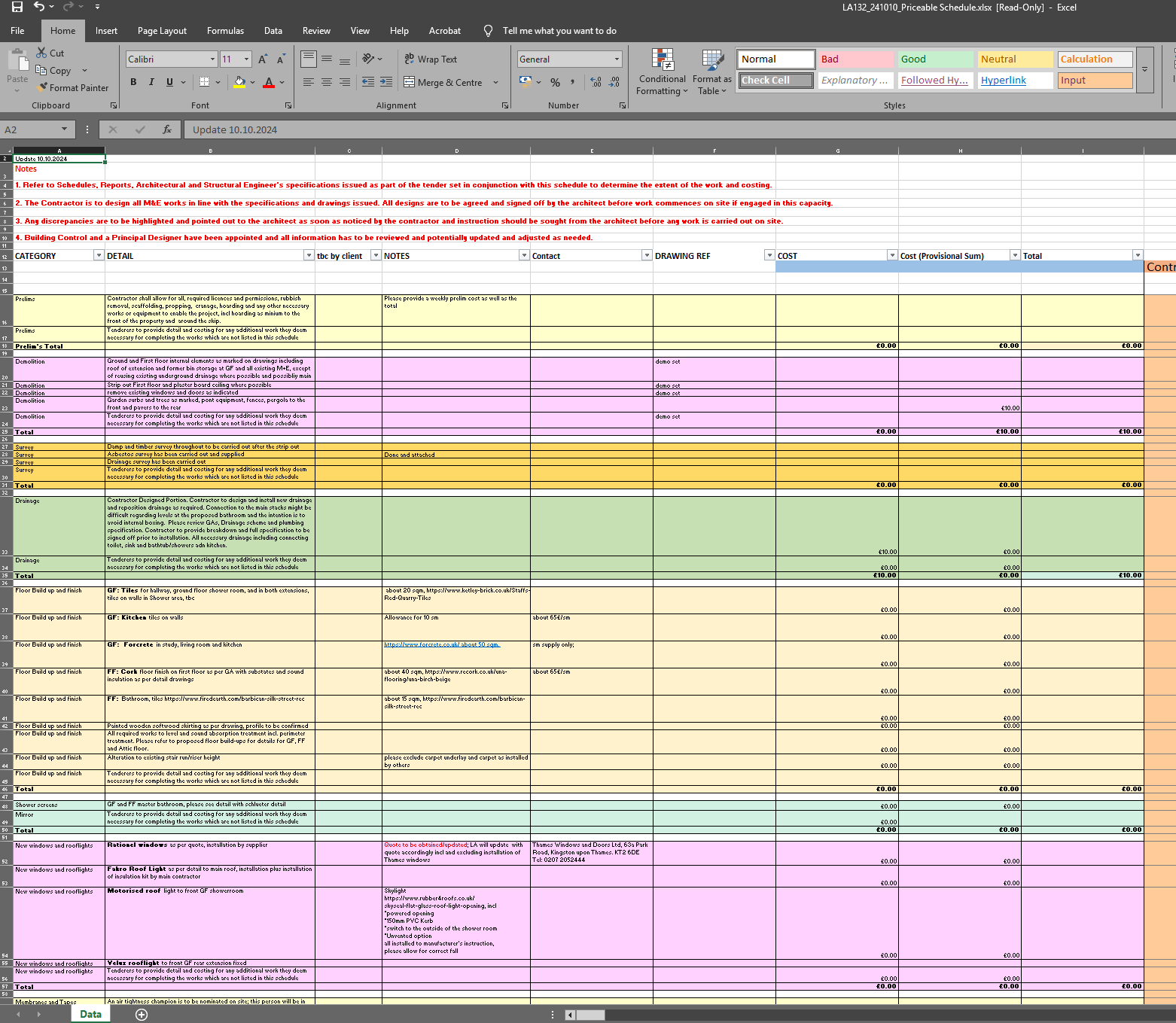
A detailed Priceable Schedule extract
An initial Priceable Schedule forms part of our architectural services and helps establish a reliable early project budget. It is a key cost-planning tool used to forecast evolving construction costs and support informed discussions around budget, design and feasibility by clearly showing how project costs are allocated.
It allows you to:
Assess whether the proposed design is within budget at an early stage
Review an indicative construction cost breakdown across key elements and assumptions
Identify cost-saving opportunities while maintaining design quality
-
On larger or more complex projects, we often recommend the early involvement of a Quantity Surveyor (QS), typically at the end of Concept Design. A QS uses up-to-date cost data and project information and is specifically trained to advise on accurate budget planning and cost control.
An very Initial Cost Model or Elemental Cost Plan provides:
A detailed breakdown of where money is being spent
Early identification of cost pressure points
A basis for informed decision-making
Architect and QS work closely together to balance design quality and cost certainty.
-
It is common at early stages for aspirations and budget not to align. When this becomes apparent, it is essential to address it directly.
There are usually two realistic approaches:
Prioritisation — focusing on elements that add the most value and letting go of others
Phasing — securing planning for a wider scheme but delivering it in stages over time
Both approaches require realism and careful planning. Our role is to guide clients through these decisions with clarity and honesty.
Many of the biggest cost decisions are design decisions. As architects, we influence budget through:
The scale and complexity of proposals
Structural strategy and construction methodology
Material and detailing choices
Level of bespoke design
Procurement route and contractor selection
This is why budget discussions are integral to our design process from day one.
-
Budget management continues throughout the project. We do this by:
Regularly reviewing design decisions against budget
Avoiding unnecessary complexity
Coordinating consultants carefully
Preparing clear tender information
Reviewing contractor pricing rigorously
Once on site, we help manage variations, advise on cost implications and maintain transparency so there are no surprises.
Budget as an investment
Good architecture is not about ignoring budget — it is about using it intelligently.
When budget is addressed properly from Feasibility Study through to completion, clients gain clarity, confidence and control. That is when architecture delivers lasting value. We will help at every stage.